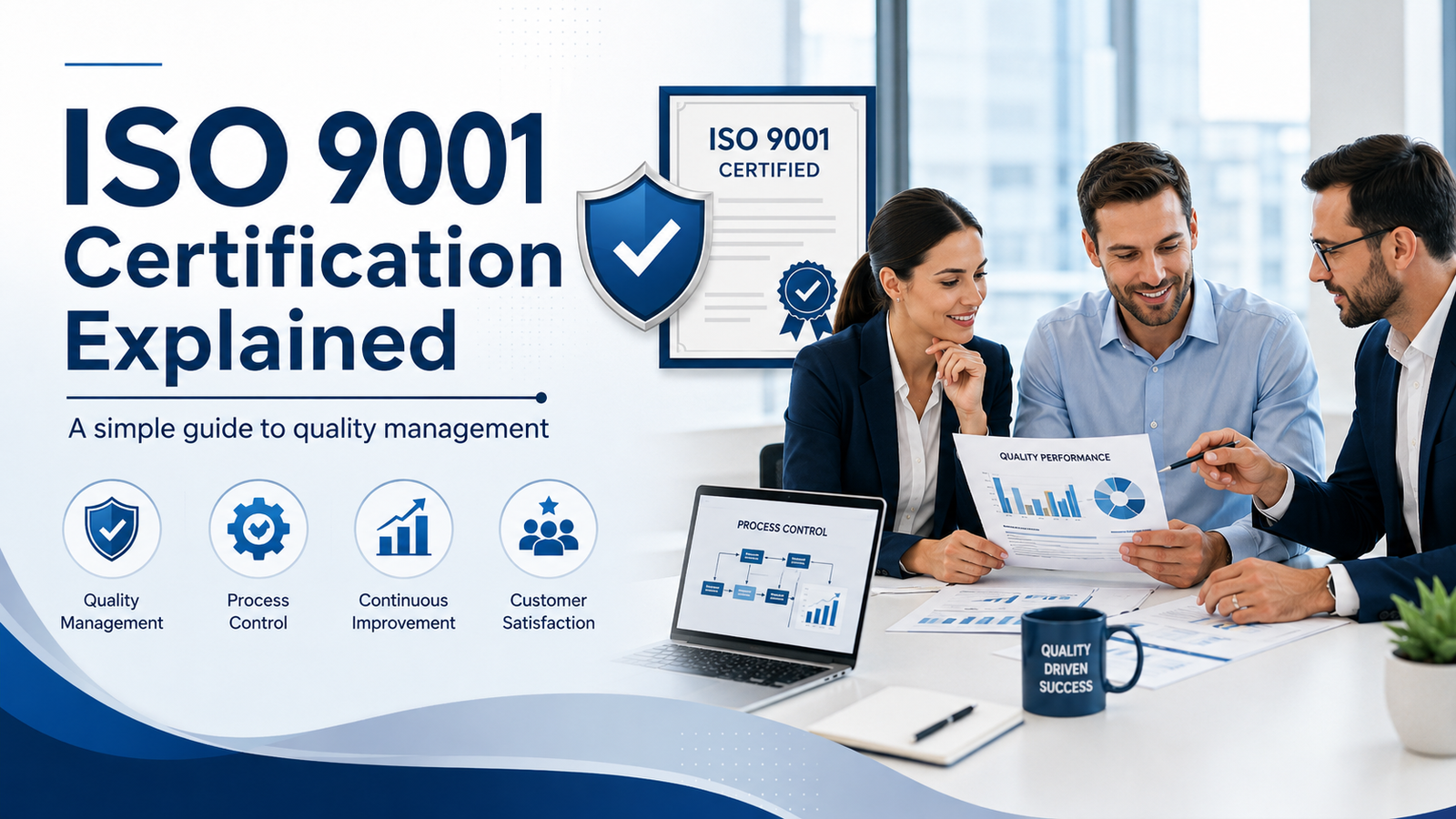
ISO 9001 Certification Explained
ISO 9001 is an internationally recognized standard for quality management systems.
It helps organizations create controlled processes, meet customer requirements, measure performance, and improve the quality of their products and services.
ISO 9001 can be used by businesses of different sizes and across different industries.
What Is a Quality Management System?
A quality management system, commonly called a QMS, is the collection of processes, responsibilities, policies, objectives, and records used to manage quality.
A QMS helps the organization answer important questions:
- What does the customer require?
- How should the work be completed?
- Who is responsible?
- How will performance be measured?
- What happens when something goes wrong?
- How will the process be improved?
ISO 9001 provides the framework for answering these questions consistently.
Current ISO 9001 Edition
As of August 6, 2026, ISO 9001:2015 remains the current published edition. A new edition is under publication and is expected to replace it in September 2026. Certified organizations are expected to receive a transition period after publication.
Businesses beginning implementation should discuss the upcoming transition with their certification adviser or certification body.
Main Areas Covered by ISO 9001
ISO 9001 addresses several important management areas.
Organizational Context
The business must understand internal and external issues that can affect its quality management system.
It must also identify relevant interested parties, such as customers, employees, regulators, suppliers, and business partners.
Leadership
Senior management must support the quality management system.
Leadership responsibilities include establishing the quality policy, setting objectives, assigning responsibilities, and ensuring that quality is part of business decision-making.
Planning
The company must identify risks and opportunities and establish measurable quality objectives.
Planning helps the organization prevent problems and focus resources on important priorities.
Support
The organization must provide suitable resources, competent employees, effective communication, and controlled documented information.
Operation
Operational processes must be planned and controlled.
This includes understanding customer requirements, managing suppliers, controlling production or service delivery, and handling process changes.
Performance Evaluation
The company must monitor, measure, analyze, and evaluate the effectiveness of its quality management system.
This includes customer feedback, internal audits, process performance, and management review.
Improvement
When problems occur, the organization must correct them, investigate their causes, and prevent recurrence.
The company should also continually look for opportunities to improve.
Benefits of ISO 9001 Certification
ISO 9001 can help a company:
- Improve product and service consistency
- Reduce errors and rework
- Strengthen customer confidence
- Improve complaint handling
- Clarify employee responsibilities
- Monitor process performance
- Improve supplier control
- Support business growth
- Qualify for certain opportunities
The value comes from using the management system in daily operations, not simply preparing documents for an audit.
What Documents Are Required?
The exact documentation depends on the organization.
Common examples include:
- Quality policy
- Quality objectives
- Process descriptions
- Operational procedures
- Training records
- Supplier evaluations
- Inspection or service records
- Internal-audit records
- Management-review records
- Corrective-action records
The objective is to maintain useful evidence and process control, not to create unnecessary paperwork.
How to Prepare for Certification
A typical preparation process includes:
- Define the certification scope.
- Review current processes.
- Complete a gap analysis.
- Develop required documents.
- Train employees.
- Implement the system.
- Monitor performance.
- Conduct an internal audit.
- Complete a management review.
- Correct identified problems.
- Arrange the external certification audit.
ISO 9001 Certification Audit
Certification is performed by an independent certification body, not by ISO itself.
The auditors review the management system to determine whether it meets the applicable requirements and is effectively implemented.
The organization should be prepared to demonstrate actual working processes and records, not only written procedures.
Frequently Asked Questions
Is ISO 9001 only for manufacturers?
No. It can be used by service providers, contractors, technology companies, educational organizations, healthcare providers, and many other businesses.
Does ISO 9001 guarantee perfect quality?
No. It provides a system for controlling quality, monitoring performance, correcting problems, and continually improving.
How long does implementation take?
The time depends on company size, complexity, available resources, and existing processes.
Improve Quality With ISO 9001
ISO 9001 can help your business create clearer processes, improve consistency, and strengthen customer satisfaction.
Contact ISOCERT PRO to discuss ISO 9001 preparation and certification requirements.

Leave A Comment