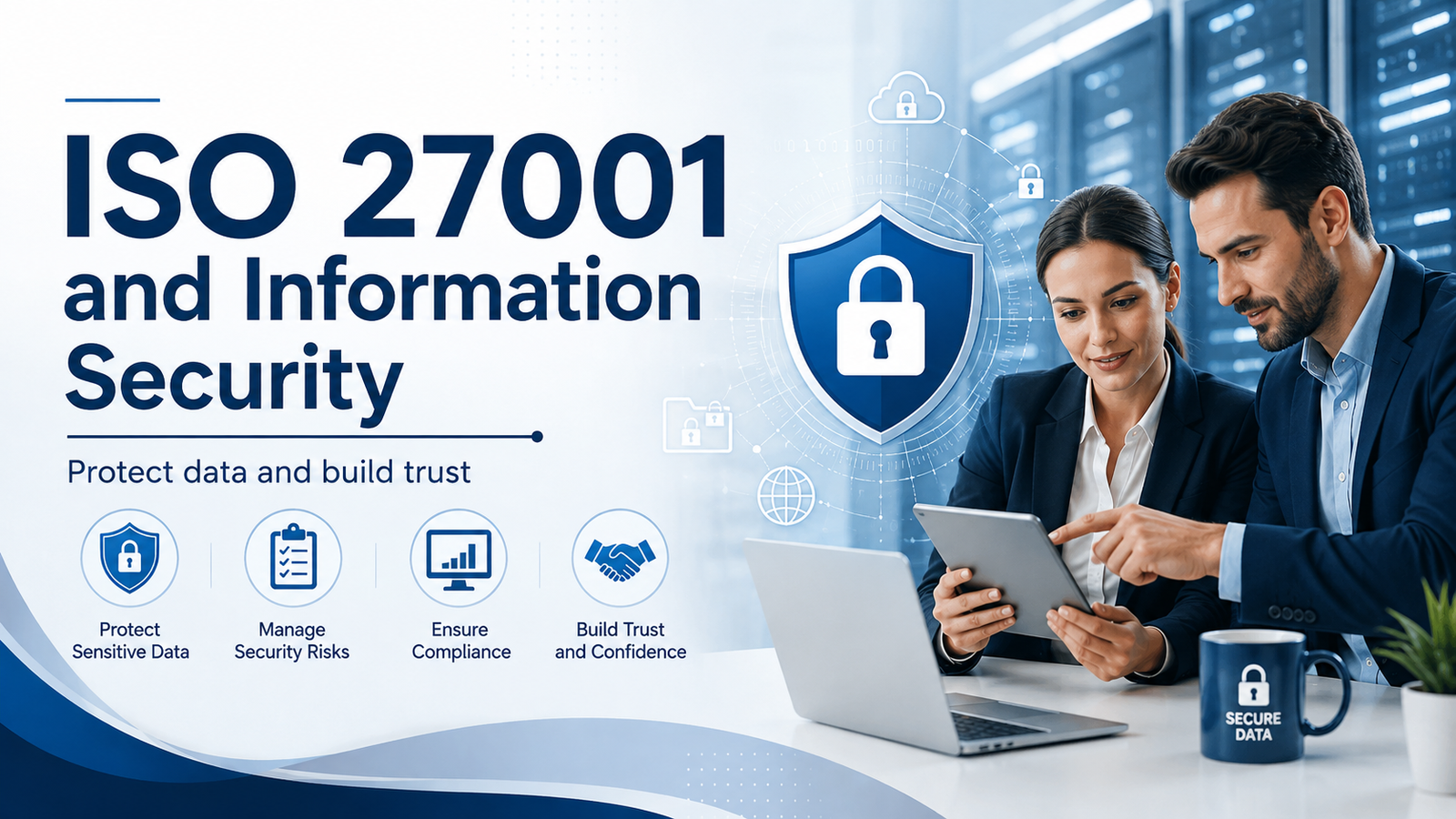
ISO/IEC 27001 and Information Security
Businesses depend on information.
Customer data, employee records, financial information, contracts, passwords, intellectual property, and operational systems must be protected from loss, misuse, unauthorized access, and disruption.
ISO/IEC 27001 provides a structured framework for managing information-security risks.
What Is ISO/IEC 27001?
ISO/IEC 27001:2022 is the international standard that defines requirements for an information security management system, commonly called an ISMS.
Although many people call it “ISO 27001,” its official reference is ISO/IEC 27001 because it is jointly published by ISO and the International Electrotechnical Commission.
What Is an Information Security Management System?
An ISMS is a coordinated system of policies, processes, responsibilities, risk assessments, controls, records, and improvement activities.
It helps an organization manage information security across:
- People
- Processes
- Technology
- Suppliers
- Physical locations
- Digital systems
- Remote working
- Cloud services
Information security is not only an information-technology responsibility. It requires participation from management and employees across the business.
Protect Confidentiality
Confidentiality means that information is accessible only to authorized people.
Possible controls include:
- Access permissions
- Password requirements
- Employee confidentiality agreements
- Secure document storage
- Encryption
- User-access reviews
- Data-classification rules
The appropriate controls depend on the organization’s risks.
Protect Information Integrity
Integrity means keeping information accurate and protecting it from unauthorized or accidental changes.
Examples include:
- Change controls
- Approval processes
- Version control
- Activity logs
- Database protections
- Backup verification
- Restricted editing rights
Poor data integrity can lead to incorrect decisions, financial loss, customer problems, or compliance failures.
Maintain Availability
Availability means ensuring that authorized users can access information and systems when needed.
Organizations may use:
- Backups
- Redundant systems
- Business-continuity plans
- Disaster-recovery arrangements
- Equipment maintenance
- Supplier controls
- Incident-response procedures
Availability is important because system failures can interrupt operations and customer service.
Complete an Information-Security Risk Assessment
Risk assessment is a central part of ISO/IEC 27001.
The organization identifies information assets, threats, vulnerabilities, possible consequences, and existing controls.
Examples of risks include:
- Phishing
- Malware
- Weak passwords
- Lost devices
- Employee mistakes
- Unauthorized access
- Supplier failure
- Data leakage
- System outage
- Physical theft
The company then decides how each significant risk will be treated.
Improve Employee Awareness
Many security incidents begin with human error.
Employees should understand:
- How to identify suspicious messages
- How to protect passwords
- How to handle confidential information
- How to report incidents
- Which devices and systems they may use
- How to work securely outside the office
Training should be relevant to employee responsibilities and updated when risks change.
Control Suppliers and Cloud Services
Businesses often share information with suppliers, software providers, consultants, contractors, and cloud-service providers.
Supplier relationships should be evaluated and controlled.
The organization may need to define:
- Security requirements
- Contract responsibilities
- Access restrictions
- Incident-reporting obligations
- Data-return or deletion requirements
- Supplier-monitoring activities
Benefits of ISO/IEC 27001 Certification
Certification can help an organization:
- Demonstrate commitment to information security
- Improve risk management
- Protect customer information
- Strengthen incident preparation
- Improve employee awareness
- Support supplier evaluations
- Meet contractual expectations
- Build customer confidence
- Improve business resilience
Preparing for Certification
Typical steps include:
- Define the ISMS scope.
- Identify information assets.
- Complete a risk assessment.
- Establish risk-treatment plans.
- Select appropriate controls.
- Develop required policies and procedures.
- Train employees.
- Implement monitoring.
- Conduct an internal audit.
- Complete management review.
- Correct identified issues.
- Arrange the external certification audit.
Frequently Asked Questions
Is ISO/IEC 27001 only for technology companies?
No. Any organization handling sensitive or valuable information may benefit.
Does ISO/IEC 27001 guarantee that no security incident will occur?
No. It provides a systematic approach for reducing, managing, and responding to information-security risks.
Does it cover paper documents?
Yes. The management system can cover information in digital, paper, verbal, and other forms.
Protect Your Business Information
ISO/IEC 27001 can help your organization protect sensitive information, manage security risks, and strengthen customer trust.
Contact ISOCERT PRO to discuss ISO/IEC 27001 preparation and certification requirements.

Leave A Comment