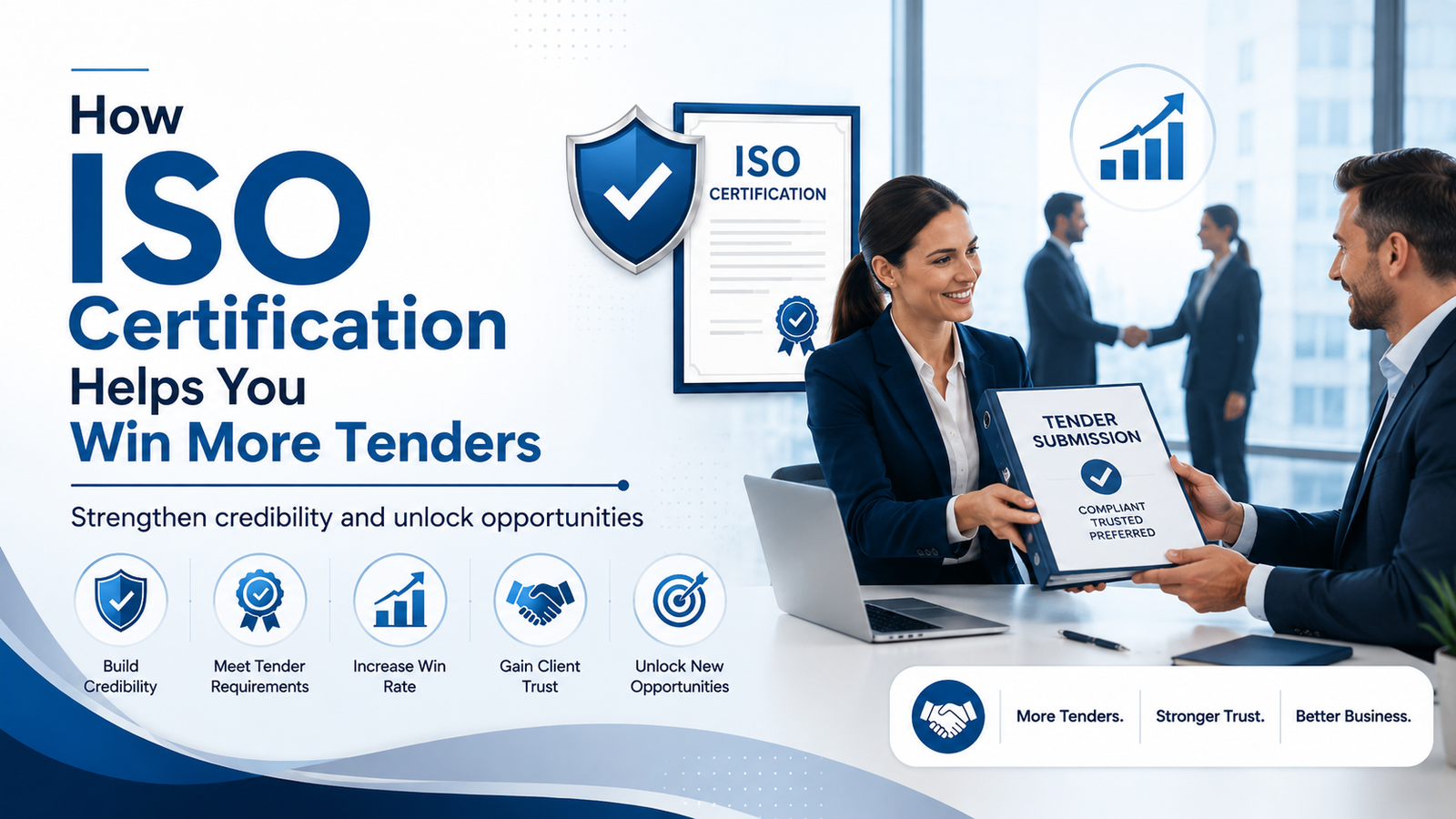
How ISO Certification Can Help Your Business Win More Tenders
Winning a tender depends on many factors, including price, experience, technical capability, compliance, resources, and the strength of the proposal.
ISO certification does not guarantee that a company will win a contract. However, it can strengthen a tender submission by providing independent evidence that the organization has implemented a recognized management system.
Meet Tender Requirements
Some tender documents specify that bidders must hold a particular certification.
Common examples include:
- ISO 9001 for quality management
- ISO 14001 for environmental management
- ISO 45001 for occupational health and safety
- ISO/IEC 27001 for information security
When certification is mandatory, a company without the required certificate may be unable to proceed beyond the qualification stage.
Always review the tender requirements carefully.
Demonstrate Organized Management
A certificate can show that the organization has established structured processes for managing important areas.
Depending on the standard, these areas may include:
- Quality control
- Customer requirements
- Environmental impacts
- Workplace hazards
- Information-security risks
- Employee competence
- Supplier controls
- Corrective action
- Performance monitoring
This can support the company’s claim that it has the systems needed to deliver the contract.
Build Client Confidence
Tender evaluators want confidence that the selected supplier can perform consistently.
Certification can provide additional assurance because the management system has been assessed by an external certification body.
This may be particularly valuable when the client has not worked with the supplier before.
Strengthen Technical Proposals
A strong tender response should not simply attach a certificate.
The proposal should explain how the management system will support contract delivery.
For example, the bidder can describe:
- How quality plans will be developed
- How risks will be controlled
- How subcontractors will be evaluated
- How complaints will be handled
- How incidents will be investigated
- How records will be maintained
- How performance will be reported
- How corrective actions will be managed
This connects the certification to the client’s actual needs.
Improve Prequalification Results
Many organizations use supplier-prequalification questionnaires before inviting companies to bid.
These questionnaires may ask about:
- Management systems
- Certifications
- Safety performance
- Environmental controls
- Data protection
- Insurance
- Training
- Previous experience
- Financial capability
Relevant certification may make it easier to demonstrate that formal systems are already in place.
Reduce Perceived Supplier Risk
Clients evaluate the risk of appointing each supplier.
A poorly controlled supplier may create delays, defects, incidents, security problems, or reputational damage.
An effectively implemented management system can demonstrate that the company has processes for identifying, controlling, and monitoring risks.
Certification is most persuasive when supported by strong performance records.
Access Larger Supply Chains
Large organizations may require suppliers to meet defined management-system expectations.
Certification may help a company:
- Register as an approved supplier
- Respond to larger tenders
- Enter corporate supply chains
- Work with international partners
- Demonstrate professional capability
- Compete for long-term contracts
The exact requirements vary between customers and industries.
Avoid Certification Problems in Tenders
Before submitting a certificate, verify:
- The company name is correct.
- The certification scope covers the tendered activity.
- Relevant locations are included.
- The certificate has not expired.
- The correct standard and edition are shown.
- The certification body can verify the certificate.
- Any required accreditation information is available.
A certificate with an unsuitable scope may not satisfy the tender requirement.
Do Not Make Misleading Claims
ISO does not issue certificates directly. Certification is conducted by independent certification bodies.
Use accurate wording such as:
“Our quality management system is certified to ISO 9001.”
Avoid saying:
“Our products are approved by ISO.”
Management-system certification normally applies to the organization’s system and stated scope, not automatic approval of every product.
Combine Certification With Strong Evidence
Certification is only one part of a successful tender.
Support the submission with:
- Relevant experience
- Case studies
- References
- Qualified personnel
- Method statements
- Project schedules
- Risk assessments
- Performance data
- Financial information
- Competitive pricing
The strongest bid combines credible certification with clear evidence of delivery capability.
Frequently Asked Questions
Does ISO certification guarantee tender success?
No. It may satisfy requirements and strengthen credibility, but the buyer will evaluate many factors.
Which certification is best for tenders?
It depends on the tender. Review the stated requirements and the risks connected to the contract.
Can a newly certified company apply for tenders?
Yes, provided it meets all tender conditions. Buyers may also request experience, financial capacity, references, or technical qualifications.
Strengthen Your Tender Readiness
ISO certification can help your business demonstrate credibility, management capability, and commitment to controlled performance.
Contact ISOCERT PRO to discuss certification requirements for supplier registration and tender participation.

Leave A Comment