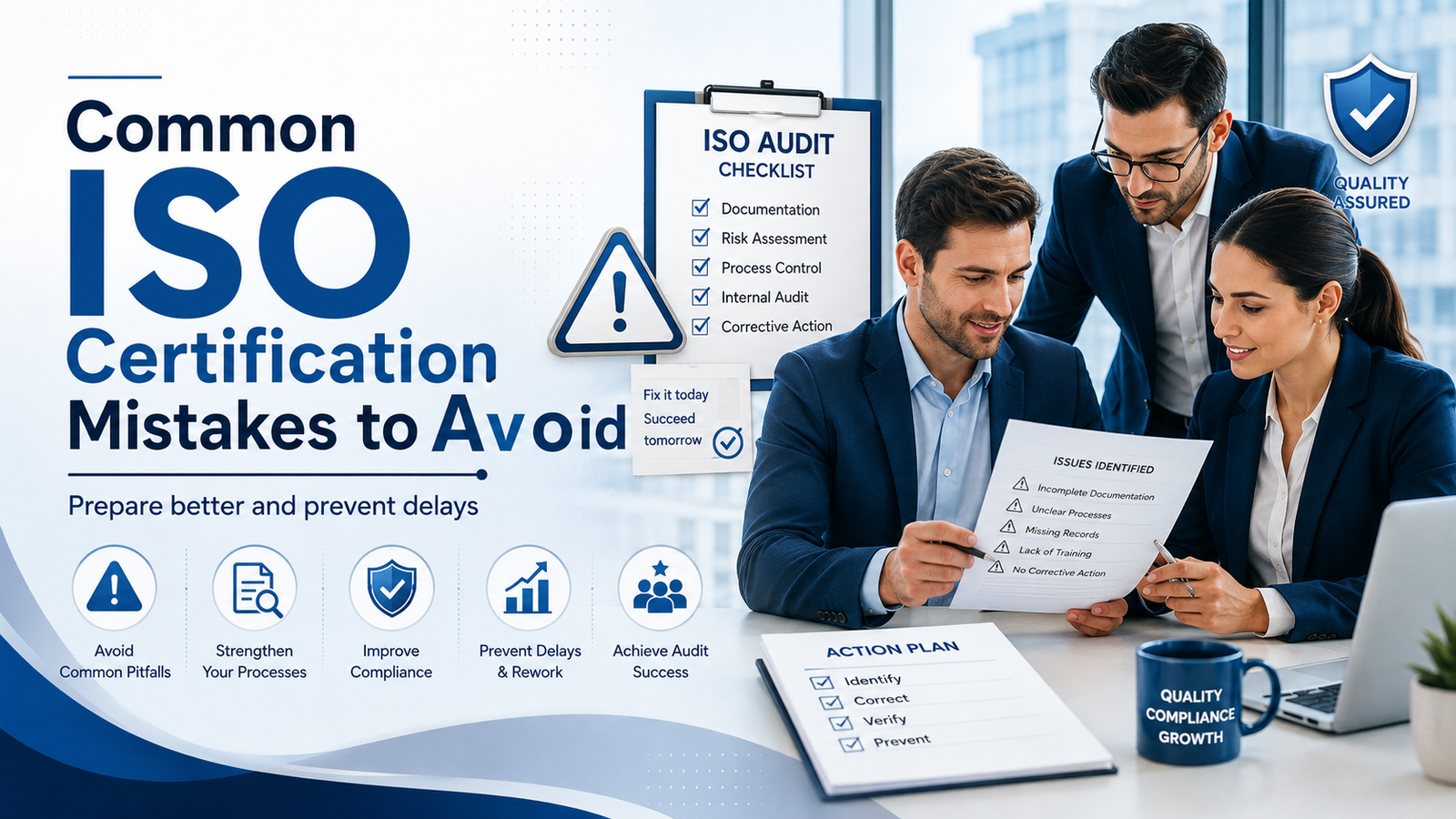
Common ISO Certification Mistakes to Avoid
ISO certification can bring important business benefits, but poor preparation may create delays, unnecessary costs, and weak results.
Many certification problems are not caused by the standard itself. They are caused by misunderstanding the purpose of the management system or treating certification as a paperwork exercise.
Mistake 1: Choosing the Wrong Standard
Some organizations select a standard without first reviewing their business needs.
For example, a company focused primarily on information security may not achieve its objective by implementing only a quality-management standard.
Before beginning, review:
- Business objectives
- Customer requirements
- Tender conditions
- Operational risks
- Industry expectations
- Legal obligations
Choose the standard that addresses the actual need.
Mistake 2: Creating Too Much Documentation
ISO implementation does not mean creating large numbers of complicated procedures.
Excessive documentation can confuse employees and make the management system difficult to maintain.
Documents should be:
- Useful
- Clear
- Controlled
- Relevant
- Easy to follow
- Consistent with actual operations
A short procedure that employees understand is often more effective than a long document they never use.
Mistake 3: Copying Documents From Another Company
Generic templates may provide a starting point, but copying another company’s management system creates serious weaknesses.
Every organization has different:
- Processes
- Risks
- Responsibilities
- Customers
- Services
- Equipment
- Suppliers
- Objectives
Documentation must be adapted to the actual business.
Mistake 4: Excluding Employees
Employees are responsible for operating many of the processes that auditors will review.
If workers do not understand the system, written documents will not be enough.
Employees should understand:
- Relevant company policies
- Their responsibilities
- Important procedures
- How to report problems
- How their work affects objectives
- Which records they must complete
Training should be practical and related to their roles.
Mistake 5: Leaving Everything to One Person
A management representative or consultant may coordinate the project, but one person cannot operate the entire system.
Process owners, employees, and senior management must participate.
Responsibilities should be distributed across the organization.
Mistake 6: Weak Senior-Management Involvement
ISO management systems require leadership.
Senior managers should not appear only during the certification audit.
They should help establish policy, approve objectives, provide resources, review performance, remove barriers, and support improvement.
Weak leadership often produces a system that exists only on paper.
Mistake 7: Performing a Superficial Internal Audit
The internal audit is an opportunity to identify weaknesses before the certification audit.
A weak audit may:
- Review documents without checking implementation
- Ignore difficult departments
- Avoid reporting problems
- Use untrained auditors
- Repeat the same checklist every year
- Fail to investigate evidence
Current international guidance for management-system auditing is provided in ISO 19011:2026.
Mistake 8: Ignoring Root Causes
Correcting an immediate problem is not always enough.
For example, replacing a missing record does not explain why the record was missing.
The organization should investigate whether the cause involved unclear responsibility, weak training, an unsuitable form, poor supervision, or an ineffective process.
Corrective action should address the cause and prevent recurrence.
Mistake 9: Preparing Only for the Auditor
A management system should improve the business throughout the year.
Last-minute preparation may create temporary records, rushed training, and inconsistent evidence.
The system should be part of normal operations long before the certification audit.
Mistake 10: Using ISO Branding Incorrectly
ISO develops standards but does not certify organizations or permit the ISO logo to be used as a certification mark. Organizations should communicate certification accurately and follow the rules of their certification body.
Do not claim that the company, product, or service is “certified by ISO.”
Mistake 11: Selecting a Certification Body Based Only on Price
Price is important, but it should not be the only consideration.
Review:
- Competence
- Recognition
- Industry experience
- Audit scope
- Contract terms
- Auditor availability
- Certificate-verification arrangements
- Customer acceptance
An unsuitable certification body may create commercial problems later.
Mistake 12: Stopping Improvement After Certification
Certification is not the final objective.
The business must continue monitoring performance, conducting audits, reviewing objectives, addressing problems, and improving processes.
A system that is not maintained will gradually become ineffective.
Frequently Asked Questions
Can minor problems prevent certification?
The result depends on the nature and significance of the findings and the certification body’s process.
Should employees memorize the standard?
No. They should understand their responsibilities and the processes relevant to their work.
Can a consultant guarantee certification?
No responsible provider should guarantee an audit result. The organization must demonstrate conformity and effective implementation.
Prepare More Effectively
Avoiding common mistakes can reduce delays and create a management system that delivers real business value.
Contact ISOCERT PRO for support with gap analysis, implementation planning, and audit preparation.



Leave A Comment