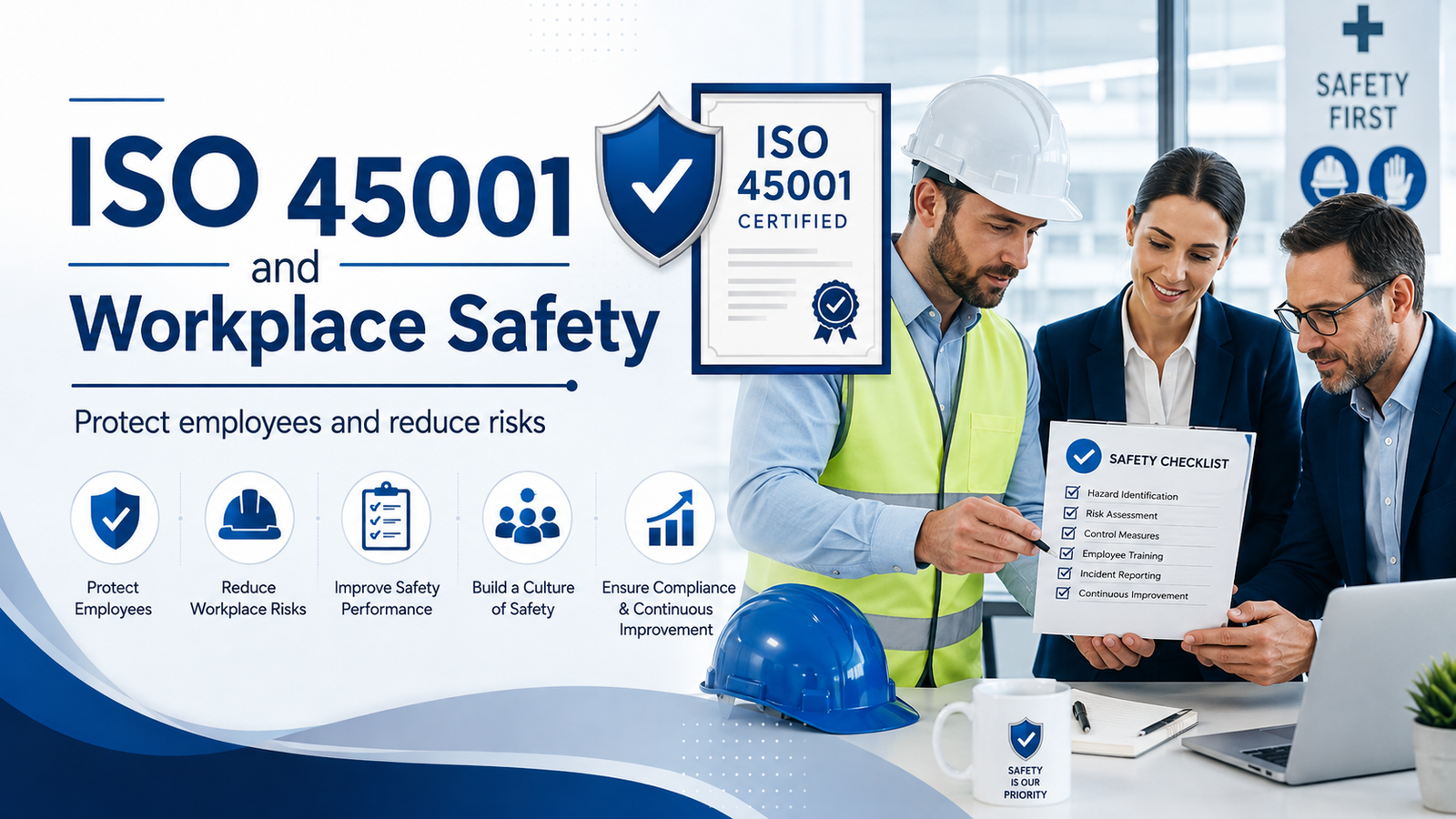
ISO 45001 and Workplace Safety
Workplace incidents can affect employees, operations, productivity, reputation, and business continuity.
ISO 45001 provides a structured management system for identifying hazards, controlling risks, involving workers, and improving occupational health and safety performance.
What Is ISO 45001?
ISO 45001 is an international standard for occupational health and safety management systems.
ISO 45001:2018 remains the current published edition as of August 2026, although a revised edition is under development.
The standard can be applied by organizations of different sizes and industries.
What Is an Occupational Health and Safety Management System?
An occupational health and safety management system helps a business organize its safety responsibilities.
It covers areas such as:
- Hazard identification
- Risk assessment
- Legal requirements
- Worker consultation
- Training
- Operational controls
- Emergency preparation
- Incident investigation
- Performance monitoring
- Continual improvement
The goal is to prevent injury and ill health while creating safer working conditions.
Identify Workplace Hazards
A hazard is anything with the potential to cause injury or ill health.
Examples include:
- Moving machinery
- Work at height
- Electricity
- Vehicles
- Hazardous chemicals
- Manual handling
- Noise
- Heat
- Poor ergonomics
- Workplace stress
- Contractor activities
The organization must identify relevant hazards and evaluate the risks connected to them.
Apply Effective Controls
After risks are assessed, the company must determine suitable controls.
Effective risk reduction generally begins by asking whether the hazard can be eliminated.
When elimination is not possible, the organization may consider substitution, engineering controls, administrative controls, training, and personal protective equipment.
Relying only on warning signs or protective equipment may not adequately control serious hazards.
Involve Employees
Worker consultation and participation are important parts of ISO 45001.
Employees often understand practical workplace risks better than people who do not perform the work.
Workers should be able to:
- Report hazards
- Suggest improvements
- Participate in investigations
- Discuss workplace changes
- Raise safety concerns
- Understand relevant controls
A positive safety culture encourages reporting without fear.
Investigate Incidents Properly
When an incident occurs, the organization should investigate why it happened.
The objective is not simply to blame an individual. A useful investigation identifies underlying causes such as weak training, unclear procedures, missing maintenance, poor supervision, unsuitable equipment, or ineffective risk assessment.
Corrective action should address the cause and reduce the chance of recurrence.
Prepare for Emergencies
Organizations must consider possible emergencies.
These may include:
- Fire
- Chemical release
- Medical emergency
- Equipment failure
- Severe weather
- Evacuation
- Electrical incident
- Vehicle collision
Emergency procedures should be documented, communicated, tested, and reviewed.
Benefits of ISO 45001 Certification
ISO 45001 can help a business:
- Improve hazard control
- Reduce workplace risks
- Clarify safety responsibilities
- Strengthen employee awareness
- Improve incident reporting
- Demonstrate safety commitment
- Support contractor management
- Improve emergency preparation
- Build customer confidence
Certification does not remove all workplace risks, but it provides a structured approach for managing them.
Preparing for Certification
A typical preparation process includes:
- Define the scope.
- Review current safety practices.
- Identify hazards.
- Assess risks and opportunities.
- Review legal obligations.
- Establish a health and safety policy.
- Define responsibilities.
- Consult workers.
- Develop operational controls.
- Prepare for emergencies.
- Monitor performance.
- Conduct an internal audit.
- Complete management review.
- Correct identified issues.
- Arrange the certification audit.
Frequently Asked Questions
Is ISO 45001 only for high-risk industries?
No. Any organization with employees or workplace risks may benefit from a structured safety-management system.
Does certification replace safety regulations?
No. The organization must still understand and comply with applicable legal requirements.
Can ISO 45001 be integrated with other standards?
Yes. It can be combined with ISO 9001 and ISO 14001.
Build a Safer Workplace
ISO 45001 can help your organization protect employees, improve safety responsibilities, and manage workplace risks more effectively.
Contact ISOCERT PRO to discuss ISO 45001 implementation and certification preparation.

Leave A Comment