How to Choose the Right ISO Standard for Your Business
Choosing an ISO standard can feel confusing, especially when several standards appear relevant to your company.
The right choice depends on your business activities, risks, customer requirements, industry expectations, and long-term goals.
Instead of selecting a standard simply because it is popular, business owners should begin by identifying the problem they want to solve.
Start With Your Business Objective
Ask what your organization wants to improve.
Your objective may be to:
- Improve product or service quality
- Reduce customer complaints
- Create safer working conditions
- Protect customer information
- Reduce environmental impact
- Strengthen food-safety controls
- Qualify for tenders
- Meet a customer requirement
Once the objective is clear, selecting the appropriate standard becomes easier.
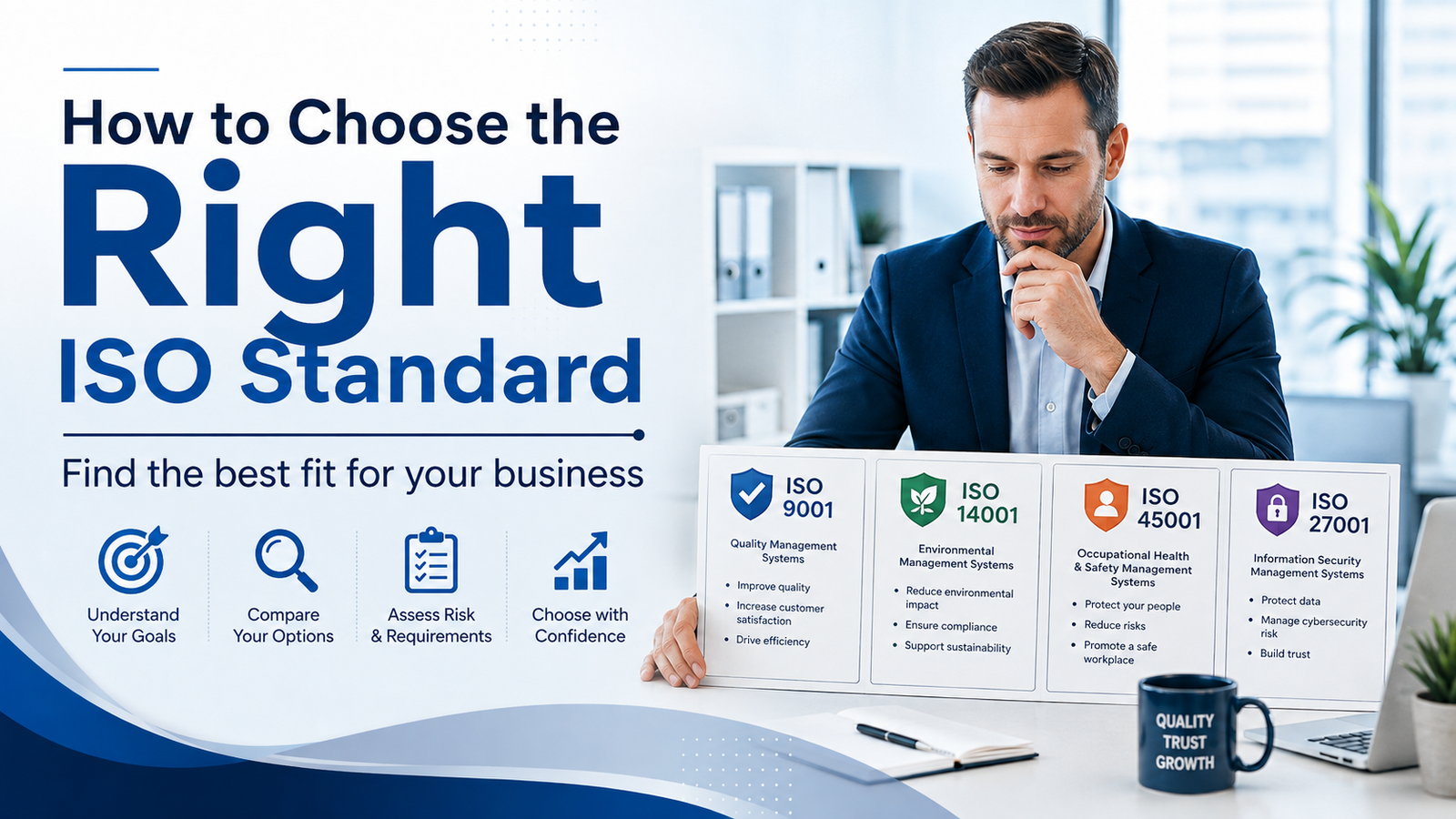
Choose ISO 9001 for Quality Management
ISO 9001 is suitable for companies that want to improve quality, customer satisfaction, and process consistency.
It can help an organization establish clear processes for delivering products or services and monitoring whether customer requirements are being met.
ISO 9001 may be suitable when your company experiences:
- Repeated customer complaints
- Inconsistent service
- Product defects
- Unclear processes
- Weak performance monitoring
- Rapid organizational growth
It is widely applicable across service, manufacturing, construction, education, healthcare, technology, and other sectors.
Choose ISO 14001 for Environmental Management
ISO 14001 is designed for organizations that want to control their environmental impacts and improve environmental performance.
The current edition is ISO 14001:2026. It provides a framework for managing matters such as resource use, waste, emissions, environmental obligations, and environmental objectives.
ISO 14001 may be suitable when your company wants to:
- Reduce waste
- Conserve energy or water
- Improve environmental compliance
- Meet supply-chain expectations
- Control pollution risks
- Demonstrate environmental responsibility
The standard can be used by both industrial and service organizations.
Choose ISO 45001 for Health and Safety
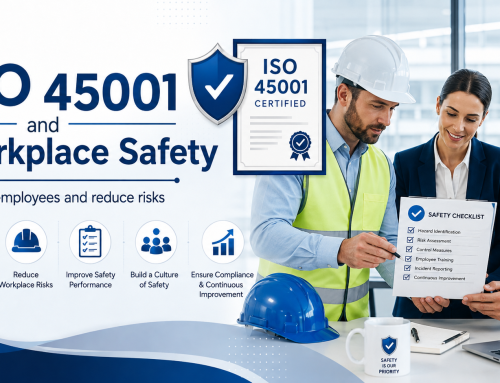
ISO 45001 focuses on occupational health and safety.
It helps organizations identify workplace hazards, assess risks, involve workers, prepare for emergencies, investigate incidents, and continually improve safety performance.
ISO 45001 may be appropriate when your company has:
- Physical workplace hazards
- Construction or industrial activities
- Machinery or vehicle risks
- High-risk working environments
- Contractor-safety responsibilities
- Customer requirements related to safety
ISO 45001:2018 remains the current published edition as of August 2026, while a new edition is under development.
Choose ISO/IEC 27001 for Information Security
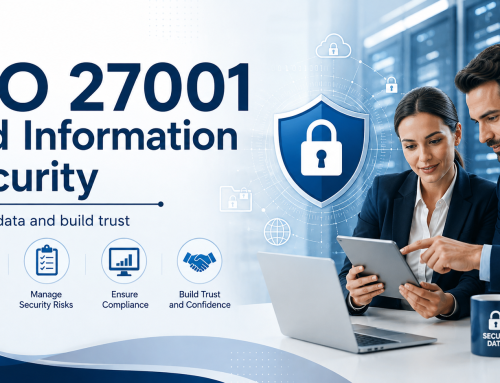
ISO/IEC 27001 is designed for organizations that manage sensitive information.
This may include customer data, employee records, financial information, intellectual property, passwords, contracts, or digital systems.
ISO/IEC 27001 may be suitable for:
- Technology companies
- Financial service providers
- Online businesses
- Healthcare organizations
- Professional service firms
- Data-processing companies
- Any organization handling confidential information
The standard helps the organization protect the confidentiality, integrity, and availability of information.
Consider Other ISO Standards
Your business may require a more specialized standard.
Examples include:
- ISO 22000 for food safety management
- ISO 50001 for energy management
- ISO 13485 for medical-device quality management
- ISO 22301 for business continuity management
- ISO 37001 for anti-bribery management
- ISO/IEC 42001 for artificial-intelligence management systems
A specialized standard should be selected according to your operations and industry requirements.
Review Customer and Tender Requirements
Some customers may specify an exact ISO standard in contracts, supplier applications, or tender documents.
Before choosing a standard, review:
- Customer contracts
- Tender conditions
- Supplier-registration forms
- Industry regulations
- Partner expectations
- Internal business risks
Do not assume that one ISO certificate will satisfy every requirement.
Consider an Integrated Management System
A business may need more than one standard.
For example, a construction company may implement:
- ISO 9001 for quality
- ISO 14001 for environmental management
- ISO 45001 for workplace safety
These standards can be combined into an integrated management system, reducing duplication and making audits and documentation easier to manage.
Complete a Gap Analysis
A gap analysis compares your current practices with the requirements of the selected standard.
It can help identify:
- Existing strengths
- Missing procedures
- Required records
- Training needs
- Process weaknesses
- Implementation priorities
Completing a gap analysis before certification can reduce delays and unnecessary work.
Frequently Asked Questions
What is the most common ISO standard?
ISO 9001 is one of the most widely used management-system standards because quality management is relevant to many types of organizations.
Do I need more than one standard?
Not always. Begin with the standard that addresses your most important business objective or customer requirement.
Can different standards be implemented together?
Yes. Several ISO management standards share a compatible structure and can be combined.
Choose With Confidence
The best ISO standard is the one that addresses your company’s real needs.
Contact ISOCERT PRO for help reviewing your business activities, customer requirements, and certification objectives.

Leave A Comment