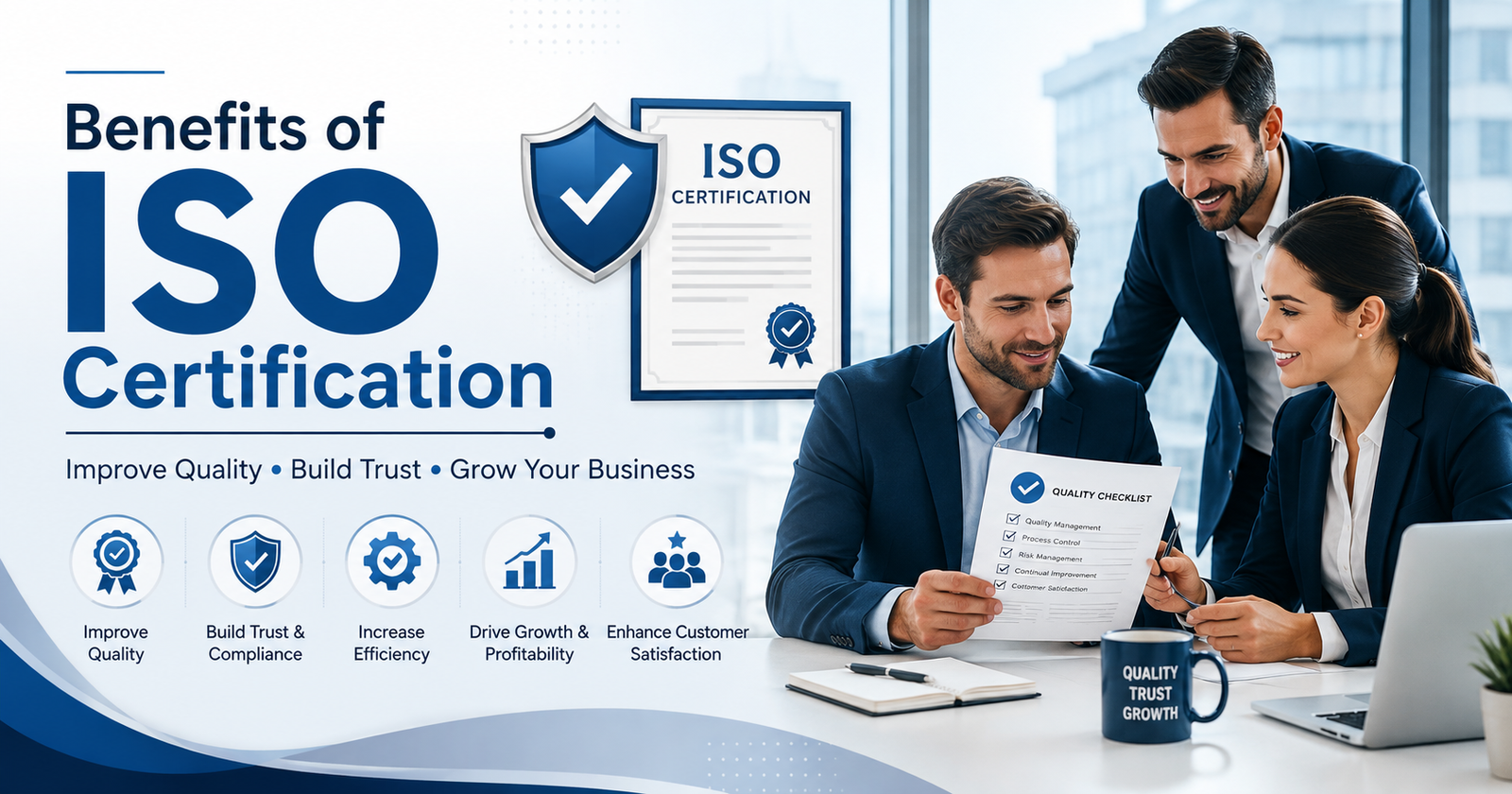
Why ISO Certification Is Important for Businesses
Business owners are constantly looking for ways to improve operations, satisfy customers, reduce risks, and build a stronger reputation.
ISO certification can help businesses achieve these goals by providing internationally recognized standards for quality, safety, environmental responsibility, information security, and other important areas.
ISO standards give companies a structured system for managing their activities. Instead of relying on informal methods, a certified business follows documented processes, clear responsibilities, regular reviews, and continuous improvement practices.
For business owners, ISO certification is more than a certificate displayed on a wall. It can become a practical tool for improving the entire organization.
What Is ISO Certification?
ISO certification confirms that a company’s management system meets the requirements of a specific ISO standard.
The International Organization for Standardization develops standards that help organizations improve the quality, safety, consistency, and efficiency of their products, services, and internal processes.
Some of the most common ISO standards include:
- ISO 9001 for quality management
- ISO 14001 for environmental management
- ISO 45001 for occupational health and safety
- ISO 27001 for information security management
- ISO 22000 for food safety management
Each standard focuses on a different part of business performance. A company can select the ISO standard that best matches its activities, risks, industry, and long-term goals.
1. Improve the Quality of Products and Services
One of the main benefits of ISO certification is better quality management.
For example, ISO 9001 helps businesses create clear processes for delivering products and services consistently. It encourages companies to understand customer requirements, monitor performance, correct problems, and improve operations over time.
A strong quality management system can help a business:
- Reduce mistakes
- Improve service consistency
- Identify the causes of recurring problems
- Establish clear quality responsibilities
- Monitor customer satisfaction
- Improve products and services continuously
When processes are controlled and regularly reviewed, the company becomes more capable of delivering reliable results.
2. Build Customer Trust
Customers want to work with businesses they can trust.
ISO certification shows that a company follows recognized management practices and has been assessed against the requirements of an international standard.
This can give customers more confidence when choosing between different suppliers or service providers.
Certification may help demonstrate that the business is committed to:
- Quality
- Customer satisfaction
- Safety
- Data protection
- Environmental responsibility
- Continuous improvement
This is especially valuable when customers cannot easily evaluate a company’s internal processes before making a purchase or signing a contract.
3. Strengthen Business Reputation
A strong reputation is an important business asset.
ISO certification can support a company’s professional image by showing that it takes management, quality, safety, or security seriously.
Businesses can refer to their certification on:
- Their website
- Company profile
- Marketing materials
- Business proposals
- Tender documents
- Email signatures
- Office displays
However, companies should always describe their certification accurately and avoid suggesting that ISO directly certifies their products.
When communicated correctly, certification can help a business appear more organized, credible, and prepared.
4. Improve Operational Efficiency
Poorly organized processes can waste time, money, materials, and employee effort.
ISO management systems require businesses to review how work is performed, identify weaknesses, document important procedures, and measure performance.
This process can reveal problems such as:
- Duplicate work
- Unclear responsibilities
- Unnecessary approvals
- Delayed communication
- Inconsistent service delivery
- Poor document control
- Repeated customer complaints
By improving these areas, companies can operate more efficiently.
Clear processes also make it easier for employees to understand what they are responsible for and how their work contributes to the company’s objectives.
5. Reduce Business Risks
Every business faces risks.
These may include quality failures, workplace incidents, information security breaches, environmental problems, legal issues, supplier failures, or customer dissatisfaction.
ISO standards encourage businesses to identify risks before they become serious problems.
For example:
- ISO 9001 addresses risks related to quality and customer requirements.
- ISO 45001 helps manage workplace health and safety risks.
- ISO 27001 helps protect sensitive information.
- ISO 14001 supports the management of environmental impacts.
- ISO 22000 helps control food safety hazards.
A risk-based approach allows business owners to make better decisions and prepare for possible disruptions.
6. Create Clear Business Processes
Many growing businesses depend heavily on the knowledge of a few employees.
This can become a problem when an experienced employee leaves, changes position, or is unavailable.
ISO certification encourages companies to document important processes and maintain controlled records.
Documented procedures can help businesses:
- Train new employees
- Maintain consistency
- Reduce dependence on individuals
- Clarify responsibilities
- Preserve important knowledge
- Improve accountability
The goal is not to create unnecessary paperwork. The goal is to ensure that important activities are understood, controlled, and repeatable.
7. Increase Employee Awareness and Involvement
Employees perform better when they understand their responsibilities and the company’s objectives.
ISO management systems require organizations to define roles, provide appropriate training, communicate expectations, and evaluate employee competence.
This can improve teamwork and help employees understand:
- What they are expected to do
- Why their work matters
- Which procedures they must follow
- How problems should be reported
- How improvements can be suggested
Employee involvement is especially important because workers often see operational problems before senior management does.
A well-managed ISO system gives employees a structured way to report issues and contribute to improvement.
8. Improve Customer Satisfaction
Customer satisfaction is connected to quality, communication, delivery, reliability, and problem resolution.
ISO standards encourage businesses to understand customer expectations and monitor whether those expectations are being met.
This may include:
- Reviewing customer requirements before accepting work
- Monitoring complaints
- Collecting customer feedback
- Investigating service failures
- Taking corrective action
- Measuring satisfaction levels
By using customer feedback as a source of improvement, companies can strengthen relationships and reduce the risk of losing customers.
9. Access New Business Opportunities
Some customers, large companies, international partners, government bodies, and supply chains may prefer or require suppliers to hold an ISO certificate.
Certification does not guarantee that a business will win a contract. However, it can help the company meet supplier qualification requirements and participate in opportunities that may otherwise be unavailable.
ISO certification can be useful when applying for:
- Tenders
- Supplier registrations
- Corporate contracts
- Partnership opportunities
- International projects
- Subcontracting work
For some businesses, certification is an important step toward entering more competitive markets.
10. Support Business Growth
As a company grows, informal processes may become difficult to control.
More employees, customers, branches, suppliers, and services can create new risks and communication challenges.
An ISO management system provides a structured foundation for growth.
It helps the company establish:
- Standard operating procedures
- Measurable objectives
- Defined responsibilities
- Performance indicators
- Internal audits
- Management reviews
- Corrective actions
These tools can help business owners maintain control while the organization expands.
11. Improve Management Decisions
Good decisions require reliable information.
ISO standards encourage companies to monitor performance and use evidence when making decisions.
Business owners and managers can review information such as:
- Customer complaints
- Delivery performance
- Product defects
- Safety incidents
- Audit findings
- Supplier performance
- Employee training results
- Progress toward business objectives
This information helps management identify priorities and decide where improvement is needed.
Instead of depending only on assumptions, the company can use actual results to guide its decisions.
12. Encourage Continuous Improvement
ISO certification is not a one-time activity.
Certified companies are expected to maintain their management systems, conduct internal audits, review performance, correct problems, and improve continuously.
This creates a regular improvement cycle:
- Plan the process.
- Perform the work.
- Check the results.
- Correct problems.
- Improve the process.
Continuous improvement helps businesses respond to changing customer needs, new risks, operational challenges, and market expectations.
Which ISO Standard Is Right for Your Business?
The right ISO standard depends on your company’s activities and objectives.
ISO 9001: Quality Management
Suitable for organizations that want to improve quality, customer satisfaction, and operational consistency.
ISO 14001: Environmental Management
Suitable for businesses that want to manage environmental impacts, reduce waste, and improve environmental performance.
ISO 45001: Occupational Health and Safety
Suitable for organizations that want to reduce workplace risks and create safer working conditions.
ISO 27001: Information Security Management
Suitable for businesses that handle sensitive information, customer data, financial records, or digital systems.
ISO 22000: Food Safety Management
Suitable for organizations involved in food production, processing, packaging, storage, transportation, or distribution.
A business may also implement more than one ISO standard through an integrated management system.
How the ISO Certification Process Works
Although the exact process may vary, ISO certification normally includes the following stages:
- Select the appropriate ISO standard.
- Review the company’s current processes.
- Identify gaps between current practices and ISO requirements.
- Develop the required policies, procedures, and records.
- Train employees.
- Implement the management system.
- Conduct an internal audit.
- Complete a management review.
- Correct any identified issues.
- Complete the external certification audit.
After certification, the company must continue maintaining and improving its system.
Is ISO Certification Worth It?
For many businesses, ISO certification can be a valuable investment.
Its value depends on how the system is implemented.
A company that treats ISO certification only as a paperwork exercise may receive limited benefits. A company that uses the standard to improve real business processes can achieve stronger and more sustainable results.
ISO certification can help business owners improve quality, manage risks, build trust, increase efficiency, and prepare the company for future growth.
Frequently Asked Questions
What are the main benefits of ISO certification?
The main benefits include improved quality, stronger customer confidence, better operational efficiency, reduced risks, clearer business processes, improved employee awareness, and access to new business opportunities.
Can a small business get ISO certified?
Yes. ISO standards can be used by businesses of different sizes. The management system should be designed according to the company’s size, activities, risks, and complexity.
Does ISO certification increase sales?
ISO certification does not automatically increase sales. However, it can improve credibility, help meet customer requirements, support tender applications, and create access to new markets.
How long does ISO certification take?
The time required depends on the size of the business, the selected standard, the number of employees, the complexity of operations, and the company’s current level of preparation.
Is ISO certification permanent?
No. Certification must be maintained through surveillance audits, continued compliance, corrective actions, and regular improvement.
Can a company have more than one ISO certification?
Yes. A company can implement several standards, such as ISO 9001, ISO 14001, and ISO 45001, within an integrated management system.
Start Your ISO Certification Journey
ISO certification can help your business become more organized, efficient, reliable, and competitive.
At ISOCERT PRO, we support businesses throughout the certification journey, from understanding the appropriate ISO standard to preparing for the certification audit.
Contact us today to discuss your business needs and learn which ISO certification is most suitable for your organization.

Leave A Comment